Websites designed around your business, your customers and your goals - not a template.
Explore Websites
Build · Grow · Automate
Superior websites, intelligent software, and automation built to get work done.
Design Brains builds websites, applications, search systems and AI-powered workflows for businesses that want their technology to do more than sit there.
What we do
Four ways we help businesses move forward.
Most projects start with one of these and grow into another. A new site leads into search work; an internal tool leads into automating the process around it.
Search visibility across every way people find you - classic search, AI answers, and the data behind both.
Explore SearchCustom applications, SaaS products, dashboards, portals and internal tools built around real workflows.
Explore AppsPractical automation that connects AI to the systems your team already uses.
Explore Automation Selected work
Things we've built.
A closer look at recent projects - what the problem was, what we built, and how it works.
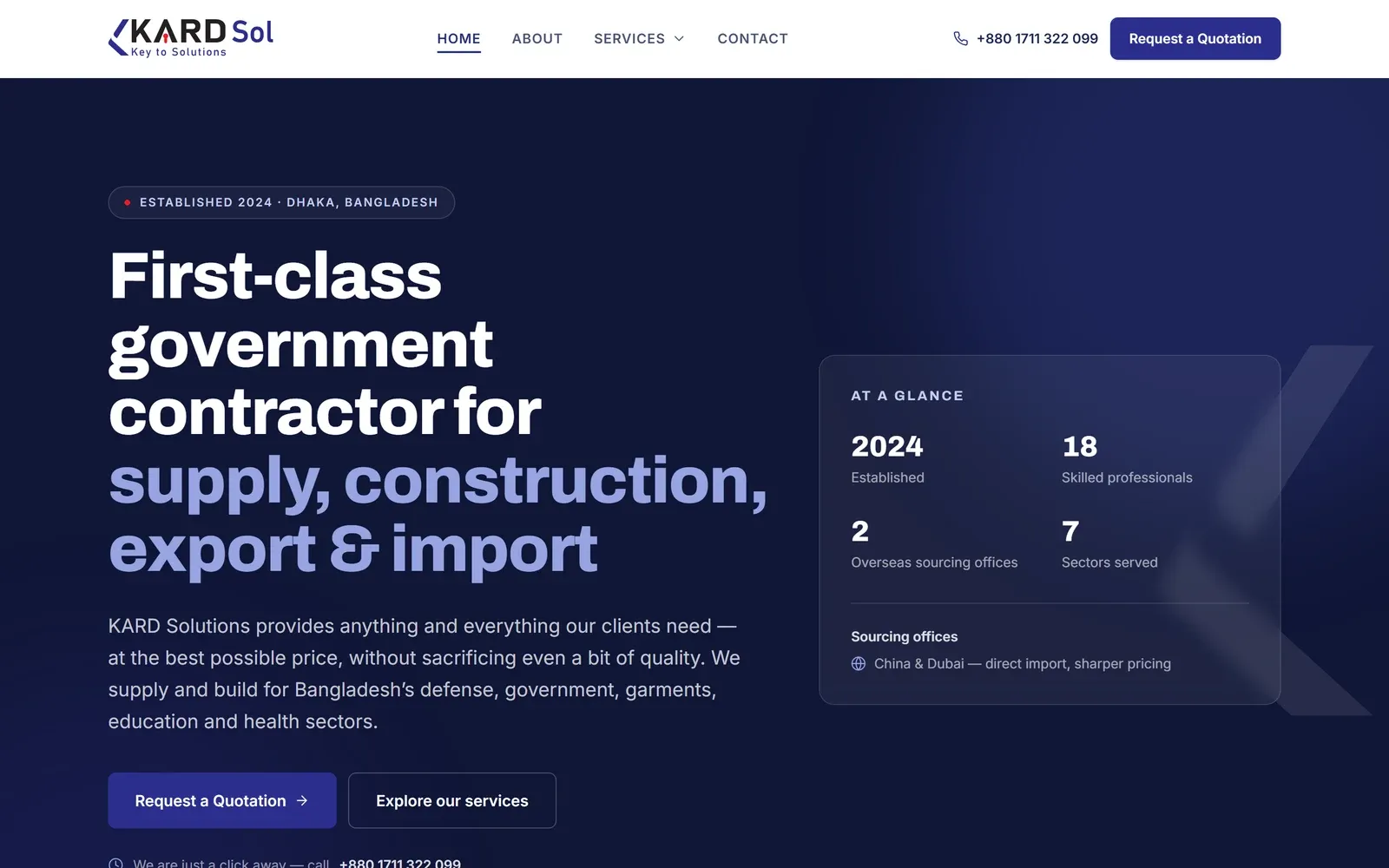 Websites
 Government & defence contracting
KARD Solutions
A static marketing and enquiry site for a Dhaka government and defence contractor, covering five service lines under one point of contact.
- Website Development
 Websites
 Ready-made garment manufacturing
Medusa Apparels
A ten-page site for a Dhaka garment manufacturer and sourcing house, built to answer a buyer's qualifying questions before the first email.
- Website Development
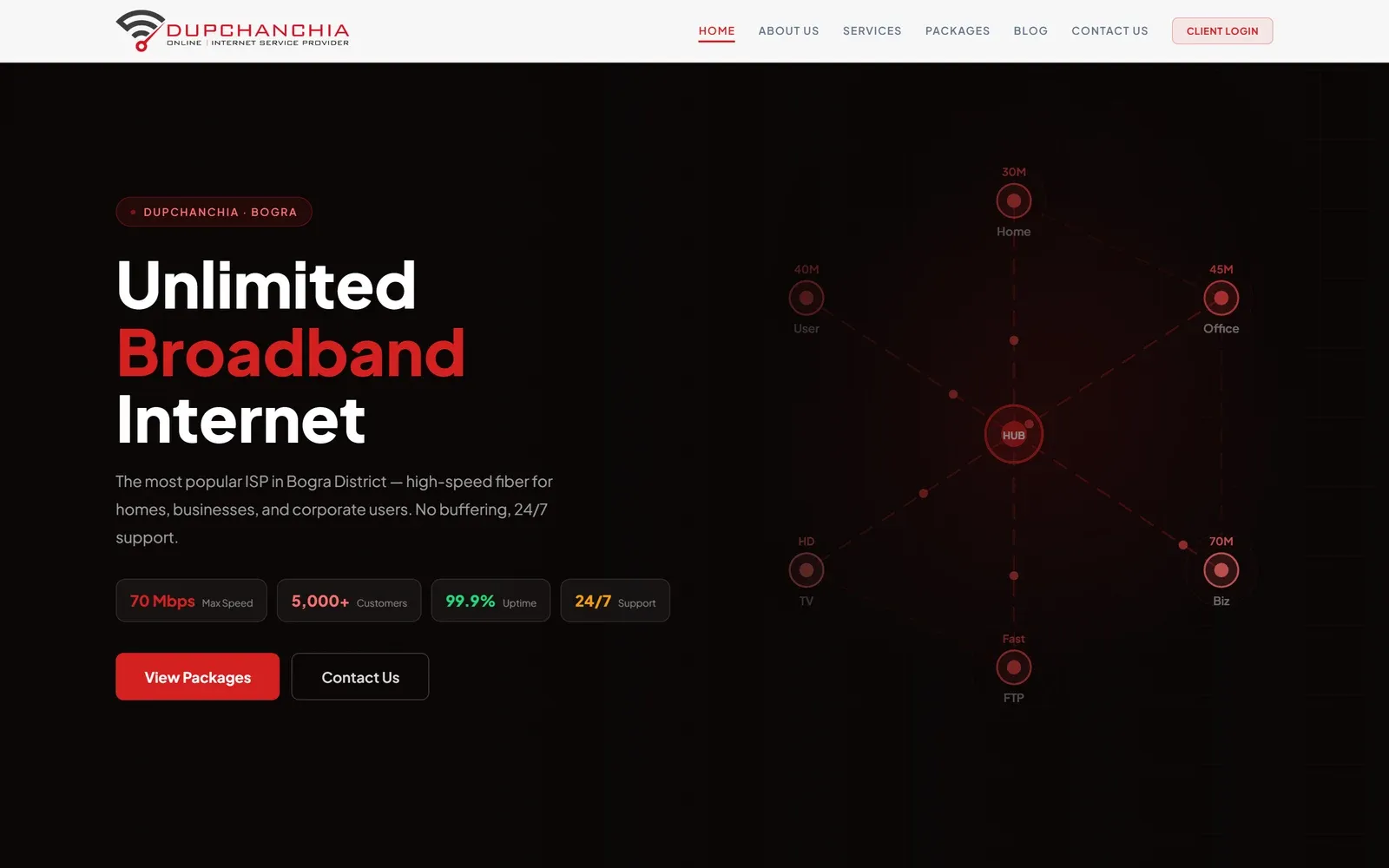 Websites
 Internet service provider
Dupchanchia Online
A package-led site for a fibre ISP in Bogra, built around the two things a prospective subscriber wants: what it costs and whether it reaches their street.
- Website Development
How we work
Good work starts before development.
Four stages, every project. You always know what is happening this week and what comes next.
- 01
Discover
Understand the business, the users, the constraints and what success actually looks like. Most bad builds trace back to a skipped question here.
- Stakeholder interviews
- Technical review
- Search and competitor analysis
- 02
Plan
Define architecture, scope and sequence. You get a written plan with priorities and trade-offs before anyone writes production code.
- Site or app architecture
- Scope and phasing
- Roadmap and estimates
- 03
Build
Design and development run together, not in sequence. You see working software early and often instead of a reveal at the end.
- Design system and UI
- Development and integrations
- Testing and review
- 04
Improve
Launch is the midpoint. We measure what happens next, fix what the data exposes, and keep improving the parts that carry the most weight.
- Launch and monitoring
- Analytics and reporting
- Ongoing iteration
Capabilities
What we actually do all day.
The disciplines behind the four services - and the reason they work better when the same team handles them.
- 01
Strategy
Understanding the problem before choosing the technology. The cheapest fix is often not a rebuild.
- 02
Design
Interfaces that make complex products easier to use, and marketing pages that hold attention long enough to explain something.
- 03
Development
Fast, maintainable websites and applications. Code your next developer can read.
- 04
Growth
SEO built into the architecture - clean URLs, crawlable structure, real internal linking - instead of bolted on after launch.
- 05
Automation
Workflows that remove repetitive manual work, with monitoring so you know when something breaks.
- 06
Support
Ongoing iteration after launch. Sites and applications decay without maintenance.
Why Design Brains
Opinions we actually hold.
01
We think beyond the interface
A website is not a collection of pages. It is part of how a business sells, explains itself and operates. We ask what the thing has to achieve before we decide what it looks like.
02
Design and development happen together
The best results come from making UX and technical decisions in the same room. Handing a static mockup to a developer at the end is how detail gets lost.
03
SEO starts in the architecture
Crawlable structure, clean URLs and real internal linking are build decisions. Bolting search on after launch is more expensive and works less well.
04
AI should solve an actual problem
We look for repetitive work worth automating rather than adding AI because it is expected. Sometimes the honest recommendation is a rule, not a model.
Insights
Ideas about websites, search, software and automation.
26 Aug 2026 · 5 min read
Custom Software vs Off-the-Shelf: How to Decide
Off-the-shelf is cheaper until it isn't. Custom is more expensive until it isn't. The decision comes down to whether your process is a competitive advantage or just a habit.
Read article22 Aug 2026 · 5 min read
What Business Processes Should You Automate?
Frequency times duration times error rate. A simple filter for deciding which repetitive work is worth automating - and which is just annoying but not expensive.
Read article19 Aug 2026 · 5 min read
What Is Technical SEO?
The layer beneath content and links: whether search engines can find your pages, read them, and understand them. It rarely wins rankings on its own - but it stops everything else from working when it is broken.
Read article FAQ
The questions people ask first.
If yours is not here, ask us directly - we answer these properly rather than deflecting to a call.
01 What does Design Brains do?
We build, grow and automate digital products. In practice that is four things: website development, SEO, app development and AI automation.
Most projects start with one of them and grow into a second. A new website often leads into search work; an internal tool often leads into automating the process around it.
02 How does a project start?
You send us a description of what you are trying to do. It does not need to be a formal brief - a few paragraphs is enough to tell whether we are a fit.
From there: a call to understand the problem, then a written proposal with scope, sequence, timeline and cost. Nothing is billed before that proposal is agreed. If we do not think we are the right people for it, we will say so and point you somewhere better.
03 How does pricing work?
Two models, depending on the work. Defined projects - a website, an application, an automation build - are quoted as a fixed price against a written scope, so you know the number before it starts. Ongoing work like SEO or continued development runs as a monthly retainer.
Cost is driven by scope, integration complexity and how much is genuinely custom versus configured. We give you a real number after a scoping conversation, not a range on a pricing page that changes once we understand the project.
04 How long does a website take?
A focused marketing site is usually a few weeks; a larger site with custom functionality, integrations or a content migration takes longer. The variable that moves timelines most is not development - it is content and decisions.
We give you a schedule with dates in the proposal, and we tell you which parts depend on you so nothing stalls silently.
05 What are GEO and AIO, and are they different from SEO?
SEO is being found in a list of results - Google, Bing, the traditional ten blue links. GEO, generative engine optimisation, is being cited inside an AI-generated answer, in ChatGPT, Gemini, Claude, Perplexity or Google's AI overviews. AIO, AI optimisation, is the wider work underneath both: making your content, entities and structured data legible to machines rather than only to people.
They are not three separate disciplines with three separate budgets. Most of the underlying work overlaps - clean structure, clear answers, credible sourcing. What changes is that you are now writing for a system that summarises you as well as one that links to you. More on how we approach all three.
06 What can businesses actually automate with AI?
The realistic wins are unglamorous and repetitive: reading incoming documents and pulling out structured data, triaging and routing enquiries, qualifying and enriching leads, drafting first versions of routine replies, summarising long threads, and moving data between systems that do not talk to each other.
If a task has a clear input, a repeatable judgement and a defined output, it is a candidate. See AI automation.
Start here
Have something worth building?
Tell us what you're trying to build, improve, or automate. We'll help you figure out the right next step.